

Maximizing Endurance Performance with Carbohydrate Loading Techniques

Updated: Aug 17
The basic overview of glycogen which is the key to carb loading
Glycogen is the stored form of carbohydrate in the body, serving as a vital energy reserve that can be quickly mobilized to meet the body's energy demands during periods of increased activity or fasting. It is composed of long chains of glucose molecules linked together in a branched structure, allowing for rapid breakdown when energy is needed.
The significance of glycogen extends beyond mere energy storage; it plays a crucial role in maintaining blood glucose levels, particularly during exercise and between meals. During a long run or ride, the body requires glucose. This glucose is either supplied by food that was consumed prior to the workout or during the workout or from glycogen. Glycogen is broken down through a process known as glycogenolysis, releasing glucose into the bloodstream and providing immediate energy to muscles and other tissues.
Glycogen is primarily stored in two major locations within the body:
Muscles (mostly in Muscles): The majority of the body's glycogen is stored in skeletal muscles, where it serves as a readily available energy source during physical exertion. Muscle glycogen is crucial for athletes and individuals engaging in high-intensity workouts, as it can be quickly converted to glucose to fuel muscle contractions and sustain performance.
Liver (smaller amount in liver): The liver also stores glycogen, albeit in smaller quantities compared to muscles. Liver glycogen plays an essential role in regulating blood sugar levels. During periods of fasting or between meals, the liver breaks down its glycogen stores to release glucose into the bloodstream, ensuring a steady supply of energy for vital organs, including the brain.
Understanding glycogen's role in energy metabolism is critical for optimizing athletic performance and maintaining overall health. Adequate glycogen stores can enhance endurance, improve recovery times, and support sustained physical activity. Conversely, depletion of glycogen reserves can lead to fatigue, decreased performance, and impaired metabolic function.
For endurance athletes, glycogen is not merely a storage form of carbohydrate; it is a fundamental component of energy metabolism that plays a pivotal role in physical performance. This also helps to understand why carbohydrate loading can be such a useful strategy for athletes wanting to gain a performance advantage in long duration training or races.
Why does Glycogen matter?
Glycogen is the primary fuel source for moderate/high-intensity endurance exercise and helps delay:
Fatigue
“Hitting the wall”
Bonking
What is the role of carbohydrate loading and glycogen?
Carbohydrate loading increases muscle glycogen stores above normal levels, also known as supercompensation.
This increase in glycogen stores helps athletes to maintain their goal pace for longer and prolongs the amount of time an athlete can compete before bonking or experiencing fatigue.
Carb loading is not eating one large pasta dinner the night before a race. It is a structured increase in carbs over several days.
Who should carb load?
Athletes competing in competitions lasting longer than 90 minutes would benefit. This includes:
Marathon
Ironman and half Ironman
Long cycling events - 90 min/2 hours or longer
Ultra-endurance running and cycling
Races lasting longer than 90 minutes, so maybe half marathon
Long runs in prep for a marathon/longer training sessions (2-3 hours or longer) that are higher in intensity
Who may not need to carb load:
Shorter races
Sprint triathlon
5k/10k
Easy training runs
The longer and intense the event, the more valuable glycogen stores become
Historical perspective
Carbohydrate loading has been around for a while. The old-school depletion protocol was a 6-7 day protocol where an athlete would consume a low carbohydrate diet for 3 days followed by a high carb diet. The experts once believed that the initial carb “depletion phase” helped the body produce more glycogen once the carbs were re-introduced. Recent research suggests this is not necessary and that simply doing the carb loading phase alone provides similar adaptations. The carb depletion stage can lead to mental or physical fatigue and could often backfire if not done correctly. This is because an athlete could be susceptible to illness during the carb depletion phase and may go into the race under-recovered and feeling bloated.
There is even a more extreme low-carb depletion protocol where athletes would take it to another level. This protocol included a combination of both a low carb diet and higher training volume for a period of time to deplete glycogen followed by a very high carb diet and low training for 4 days prior to competition.
Recent research suggests these methods were difficult and unnecessary. The benefits are similar if not better if an athlete does the carb loading phase without the depletion phase. Why make it more difficult than it needs to be? The taper week can bring with it several challenges including the anxiety that comes with prepping for a big race or even traveling.
Modern/Current carb loading recommendations
The modern approach combines the taper phase with an increase in carbohydrate intake in the days leading up to the race. This combination works well because tapering reduces glycogen use, and the increase in carbohydrates during the carb load allows muscles to store more glycogen.
Typical recommendations
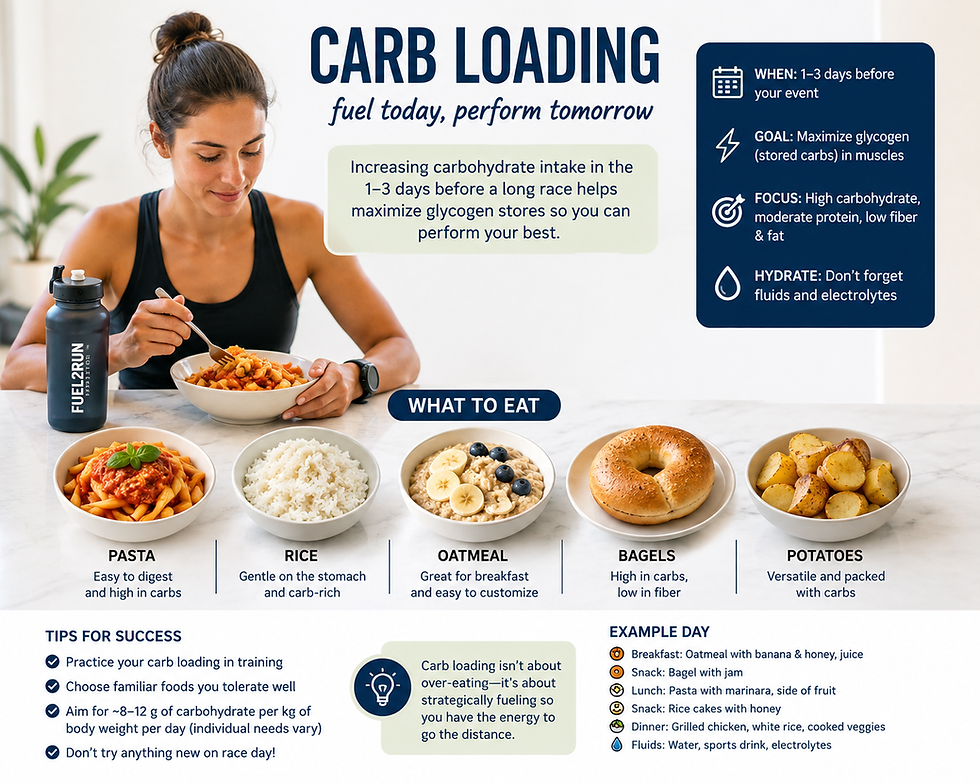
~8–12 g carbohydrate/kg body weight/day. In my experience, consuming 12 grams of carbohydrates per kilogram of body weight is hard to do, especially when exercise has been reduced substantially during a taper phase. I recommend 8-10 if possible and do this 2-3 days prior.
The carbohydrate load will usually last 1–3 days pre-race depending on the event. For a shorter event like a half marathon or a long workout, you may only need 1-2 days. For a long-duration event such as anything that is a marathon or longer, 3 days tend to work well.
Let’s take myself as an example. To get 10 grams per kilogram, I would need to consume 500-600 grams! That is a lot of carbs!
Another method to consider is to increase the carb load days more gradually and peak 1-2 days before at that higher carb amount. So maybe start the load 4 days out with 6 grams/kilogram. For me, that is 350 grams of carbs on day 1, then on day 2 maybe 400 grams, then try to aim for 400-500 grams for the 2 days leading up to the race. This approach might make the carb load a bit easier.
Individualization of the carb load
Smaller athletes vs. larger athletes: larger athletes may need more carbs, which can seem like a very difficult task. In this case, it might be okay to aim for 6-8 grams per kilogram or even use something like adjusted body weight to plan the carb-loading goals.
GI tolerance differences - some people experience more GI disturbances with certain types of carbs, so this needs to be a consideration.
Experience level matters - I recommend trying out a carb load before a B race or harder training session first. Get used to the feeling of eating that many carbs and practice how you will carb load. This way, you will be more comfortable doing the carb load before your big event or A race, where it matters the most.
Mistakes that many athletes make during a carb load
Eating too much fat! Too much fat and carbs can increase feelings of bloating and fullness, making the carb load extremely hard and adding unnecessary calories. For instance, I really like potato chips, but they are high in both fat and carbs, so I don't use them for my carb load. You will also want to be more careful with spreads such as peanut butter or cream cheese.
Too much fiber. This is where traditional health recommendations and sports nutrition recommendations collide. For your general, day-to-day nutrition, getting higher fiber carbs is absolutely a good idea. For carb loading, it is not a good idea because all of that fiber could cause some major GI issues. Trying to get all of your carbs for a carb load with higher fiber options like whole grains, beans, or fruits could increase your daily fiber intake and cause major GI upset. This can also cause trouble on race day if you have residual fiber in your gut during the race. This is why limiting fiber a few days prior to the race is a good idea.
Keep protein moderate. Don’t make too many changes to your protein intake during the carb load. You should be adding more carbs to your diet and avoid adding more protein or fat, which can also cause GI issues and may also add unnecessary calories.
Worrying that carb loading will cause weight gain. There is a temporary gain in water weight related to the increase in glycogen. This is not a permanent weight gain. Eating high carb for 2-3 days prior to an event is not enough time in carb loading to gain any substantial fat or permanent weight.
If you are using a CGM, I urge you to either take it off or only use it for educational purposes during the carb load. Your glucose levels will spike, and that is a sign the carb load is working. This is an instance where optimal performance and optimal health do not jive well. In my experience, watching the glucose levels spike during the carb load caused anxiety and was not worth whatever data I was getting on the monitor.
What carb loading looks like in real life:
Examples of carb-rich foods
Rice - white rice is best
Pasta - regular pasta, not the bean pasta or the high protein pasta
Potatoes - white or sweet both work, but maybe avoid the skin for now
Bagels - any type of bagel
Bread - preferably white
Oatmeal - this is a whole grain, so don't overdo it
Fruit (low fiber and high sugar fruits like bananas, applesauce, watermelon, or mango might work best here)
Sports drinks - high carb mixes are great
Pretzels
Pancakes
Low-fiber cereals
An example carb load with the goal of 400-500 grams per day:
Breakfast: Regular or gluten-free bagel with fruit jelly (60-70 grams of carbs), 1 cup fruit juice (30 grams of carbs), Greek yogurt with ½ cup berries and 1 tablespoon of maple syrup (20 grams of carbs). Total = 120 grams carbs
Snack: 2 oz pretzels and 10 oz high carb drink mix (half mixture of 45 grams carbs) = 90 grams carbs
Lunch: 2 slices of bread with deli meat and 1 slice of cheese (30 g carb), 1 banana (30 g carb), 1 cup fruit juice (30 g carb) = 90 grams
Snack: 1 cup sushi rice with some wine vinegar wrapped in nori dipped in soy sauce (60 grams carbs) = 60 grams carbs
Dinner: 1 cup pasta with lean meat sauce and small side salad = 60 grams carbs
Dessert: 1 cup rice Chex with milk = 40 grams of carbs
Total carb = 460 grams of carbs
Additional tips for carb loading:
Here is another reminder to choose lower fat and lower fiber foods to avoid gut issues
Simpler carbohydrates work better because it is easier for the body to process
Smaller frequent meals make it easier to get all of the carbohydrates necessary for the carb load. It is going to feel challenging to get all of the carbs needed for the carb load. This is not easy.
Don't wait until race week! Practice at least once prior to your big race during a long workout or race simulation.
If you have a nervous stomach before a race, eating more regularly helps, and getting more liquid carbs can help.
Carb loading does not replace race morning fueling or fueling during the event! You still need to fuel before your event and during the event.
Race morning meal basics
Consume a high carb meal about 2–4 hours before your event
You want to continue to stick with easy-to-digest carbs
Moderate/low protein - generally 20 grams of protein or less
Low fat/fiber (less than 10 grams of fat and 3 grams of fiber is a good rule of thumb)
Combining carb loading with a good pre-race morning fueling plan and carbs during the event can be a powerful performance tool!
Check out my Deep Dive video on the topic of Carb Lading for Endurance Athletes:
Or click on the image below to go the The Endurance Athlete Journey Podcast to listen to the podcast


Comments